Pinterest

Follow Me on Pinterest

Wednesday, May 22, 2013

Morning Hills Over the Santa Ana RIver

The morning shadows in the low parts of the hills and their colors were what drew me to this scene.

I really liked the compostition of the river leading the viewer into the painting and the contrast between the color of the river against the colors of the hills.  The quality of my quick sketches has improved since I began doing them.
Because there was going to be so much detail in the shadows, I wanted to get all the shapes down right away so I could work within those shapes to get the values and colors right.


Santa Ana River From the Bridge

Once I had established the drawing of the painting I then focused on the hills before the light changed beyond what initially interested me.

I continued to work the colors and values in the hills because I wanted to capture their feeling.  Everything else in the painting would be compared to those hills so I wanted to get them close to what I wanted.

I then worked on the foliage and finally the river.  I kept comparing the colors and the values until I thought I had gotten it right.

The View From The Bridge


I painted in the middle of the bridge which presented difficulty when there was traffic and people using the sidewalk.  Everyone was understanding and I moved my easel when I needed to.  The view was worth it.


This was the finished painting.  I think the values in the plants and trees should have been punched up so the trees in the distance would not stand out so much.

Tuesday, May 21, 2013

Second Painting of the Day in Heisler

When the weather and the location are this perfect the need to paint is so strong it can't be denied.


With the board a purple color I used a cool red to do the initial drawing.  I blocked in the ocean with a dark green.
I then overlayed a turquoise over the green and put in the shadows with a dark blue.

Rockpile


 I continued to work on the blocking in and painting rather than drawing in the early stages of the painting so that the mark making would be fresh at the end of the painting.

As I worked the rocks and tried to establish the shadow patterns I ran into some trouble with the amount of detail I already had.  Because the light was changing quickly it was difficult at times to remain true to my initial impression of the shadows and highlights.  I was constantly referencing my earlier observations to the current conditions and found myself chasing shadows.
I also had some difficulty finding the right mix of blues and greens for the water.  Because I have been painting seascapes a lot lately, I had burned through quite a few of my colors and was put in a position where I thought I had to improvise more.  I think I am ready to start painting plein air with oils.  I will need to get some new paint because I don't want to use my Old Holland outside.  It is way too expensive.

Painting in Heisler with Saim


I found myself itching to paint.  I was here to learn from the founder of the LAPAPA.  Saim had a very laid back style.  I was waiting for the most important advice on plein air painting I could get; but it wasn't coming.  That was not where he was at that day.  He had been an art teacher for so many years.  He had just flown in from Hawaii and was flying to Paris the next morning to paint in Provence with some friends.  I think he just wanted to paint.  I am pretty sure he was tired and looking to relax.  At one point in his demonstration he said to me "Are you going to start your painting?"  As usual, I had the biggest surface by far.  Some of the other attendees had already started and my parking meter was literally running.  I only brought enough quarters for three hours and there was no where to get more with out packing up all of my stuff-and that wasn't going to happen.  The year before I was going to a paint out with Saim and he cancelled at the last minute.


I normally would not have picked this view.  It is not as dramatic as many others available at this amazing park.  In fact this may be the richest place I have been for subject matter.  It seems there is one amazing view after another.  From our vantage point there were countless possibilities.  The beauty of art and the artist is the perspective and choices that are made.  Most would choose the obvious, the cliché.  Each artist sees things differently.  It is a small thing and yet it is the biggest thing at the same time-if that is possible.  Some would say that every painting done at Heisler is a cliché because it has been done an uncountable amount of times.  I would say that what is in the heart of the creator of the painting while he/she is painting determines whether it is a cliché.


I was hesitant with this composition because the palm trees were chopping up the painting in such a way that my center of focus was confused.  I had to move so that the palm's were in between the land and the rock in the ocean.  This was a compromise because I had wanted to really connect the rock with the land through the motion of the ocean.  When Saim came over for a quick look I asked his opinion.  It was interesting that he did not give it until he was asked.  This is a level of respect that I admire.  It had nothing to do with the quality of my painting or the lack of quality; it was just how he was as an artist.  He said I had too many diagonal lines running off the surface on the right and that I should bring up the lower right hand corner of the foreground.  He also suggested having the water cut into the foreground to break up that diagonal.

Saim's View


 In this painting I again focused on more painting and less drawing.  After watching Saim paint for an hour, I am sure that some of his color choices rubbed off on me.  We were not painting the same view but the subject matter was the same.


 There were a couple of things that I really like about this painting. The atmospheric perspective turned out well.  I usually want to keep adding detail until I have changed the painting from what I had hoped it would be to something else that I struggle with.  I also liked the way the detail level recedes into the distance.

Here you can see my attempts to follow Saim's advice.  I brought the right side up and created more variation in the shape of the water to reduce the effect of the lines running off of the surface.  The feedback I have gotten while painting has been very encouraging.  I ended up having two offers on the painting while I was working.  I sold it to a family from the San Diego area who had overheard a group of women who said they would contact me later about the painting.

Wednesday, May 15, 2013

We're Not Verbal

I went to paint down at Heisler Park again.  This time I went down to the beach to paint Rockpile.  I went down to scout out a spot and took some refrence photos.  As I came down the stairs I saw a couple of easels and knew I found some fellow painters.  I approached them and looked at a painting that the guy in the purple shirt was working on.  I talked to him for about half a minute asking about his painting and asked if I could paint with them when he said "We aren't verbal."
 
At that point as I went back to my car to get my stuff I thought that guy is a dick.  He had told me he was a teacher.  I wondered what kind of teacher he was.
 
When I got down to the beach I made my way to the opposite side of the beach.  It's funny that I was willing to paint what I considered a much poorer landscape to be among fellow painters. 
 
Whenever I see painters, I am drawn to them.  I am always hoping to meet some of the top plein air painters that are out there.  I am also hoping they will share some of their wisdom with me.  Most of the time all I get is some company while I paint.
 
I just don't get it.  Plein air painting is all about painting in the elements.  People are part of that equation.

Monday, May 13, 2013

Painting Heisler


I tried to draw less and block in more.  The idea of doing the drawing later in the process will help maintain the detail by not putting it in too soon and  covering it up later in the process.

Although there was some focus in the rocks with detail, there was more effort in establishing the major areas of the painting-sea, sky, and sand.
With very little attention to the detail the major elements and their relationship to each other has been established.  By working the masses first, it gives me the time to really build the painting.  The highlights and the light's nuances change so quickly that if they are added early in the painting you are trying to recapture that moment after it has already passed instead of being in the moment as you are painting.


Painting Heisler

 I have painted this landscape more than I have painted any other.  There is no shortage of material where I live but there is something magic about this mix of bluff, rock, sand and ocean.  This is the view looking south.  The view of this seascape from the north is probably the scene I have painted the second most.

 This location was perfect for painting.  This overlook was perfect.  I wonder how many and what great painters have painted from this very spot.

Here is the finished painting.  This painting like almost every other painting this shape measures 24"X36".  This painting feels like a fuller expression overall than some of my more recent paintings. 

Wednesday, May 8, 2013

Sage Study in the Canyon

I painted indoors and finished up two studio oil paintings but I had the urge to paint plein air.  I went to the location where I painted at the end of the street because I saw a road that I thought might lead me into the Irvine land from a different location.  The wind was gusting up to 60 mph which was a severe test for my easel.


 As I was setting up I did not notice that the wind had caught my board and blew it down the hill.

I thought I might be going a long distance into the canyon so I reduced the amount of pastels that I took with me.  I left my Heilman box in the car.

As I was starting to set up a couple of buzzards were enjoying the combination of high winds and the thermals as they repeatedly flew just a couple of feet over my head.

Sage Study


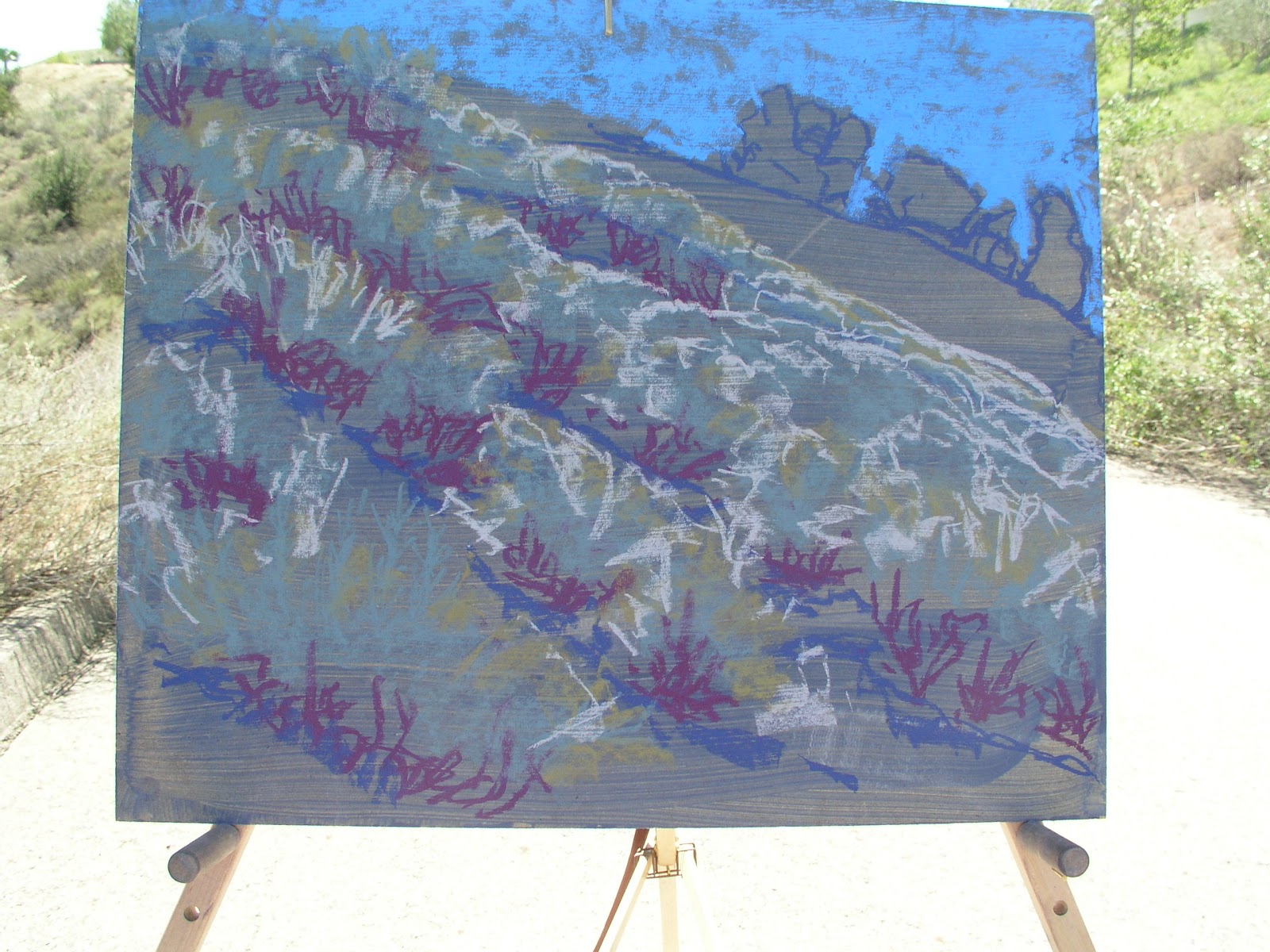
Simple and quick marks to establish the position of the sage plants.


More simple marks to establish the lines of the hill and the trees on hill in the distance.  I then add the color of the sky which sets the lighting for the entire painting.

I then blocked in the color of the sage and started to find the ground beneath the base of the sage bushes.

Sage Study

One of my common approaches is to draw the painting before I paint it.  Consequently some of the great marks I make get covered, I then try and recover them later in the painting.

In this painting I tried to not over draw the beginning part of the painting.  Because the detail would be created by a number of similar colors, I had to be careful to let some of these colors to have their space.


I worked to complete the detail in the base of each sage plant and then work through the upper branches.

Sage Study

I then started working the detail of the trees in the background and worked to create the feel of the sage moving off into the horizon.

I then went back into the sage to set some of the different values with my limited pallet.  I also created the contrast of the ground when compared to the darks of the sage.


I went in next with some of the light and mid values to create the balance within the plants.

Sage Study

I liked the way the light in this painting came through.


This painting was all about simpler.  I chose a simpler subject.  I used a simpler selection of colors.  I simplified the detail of the painting as well.

Friday, May 3, 2013

Note to Self

Note to self: When painting in pastels don't paint after putting on sun tan lotion unless you wash your hands thoroughly.