Pinterest

Follow Me on Pinterest

Sunday, October 13, 2019

Don't Be Afraid To Paint All The Snowflakes

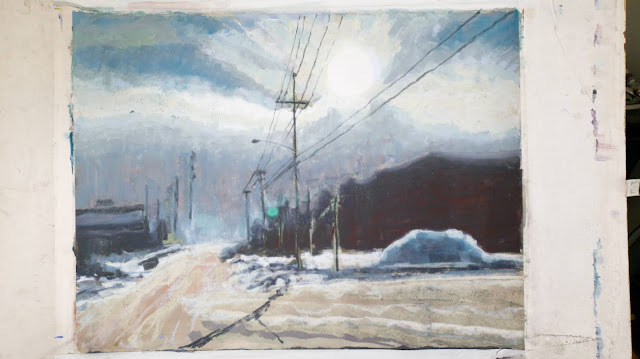
 This painting is a mixed media painting.  It has a watercolor under painting with pastel as a final treatment.
 Flexibility  in the moment is critical to good painting.  I believe that over thinking and too much concern for the outcome are limiting and does not allow a full expression.
 This painting was done for my sister in law Sue. Apparently she had sent me this picture a couple of years ago.  This was one of her favorite pictures.  While they were out visiting us with my mom I asked her to send it to me again so I could paint it.
 This is the first time I have painted from a reference photo on my phone.  It took me a while to figure out the balancing act of keeping the picture open and balancing the watercolor tray and establishing the color, composition, and values within the painting.
 Beyond the challenge of painting  from my phone was the challenge of painting an out of focus subject.  The snowflakes in this picture were stuck to the windshield and were not falling.  That was why the rest of the subject matter was out of focus.  This also was the first time I painted snow for the most part.
 The first thing to remember when dealing with new situations is to give yourself enough time.  Time has a way of removing pressure from the moment.  If you know you have all the time you need, then problem solving does not have to be pushed.  Construction priorities when followed in the proper order really help with the foundation of the painting.  Knowing you are always going to do your best without creating unrealistic expectations help you stay focused on the task at hand.  In the end every painting is an endpoint and a starting point.  The culmination of years of painting are captured in every painting  and also the starting point of some new process, thought, perspective or technique.
 Detail within the painting as with everything is about personal preference.   I love  detail.  The question of how much detail to add can be tricky  I knew I had to add the snowflakes on the wind shield because Sue mentioned how important they were to her.  The question became not if but how I was going to add the snowflakes.   They were the last thing added.  Because they are the closest thing to the viewer  they had to be the last thing I painted.  When you think of snowflakes you may think that most everything is  random.  When I was thinking about the size and placement of the snowflakes on the windshield I thought about all of the factors that resulted in their placement.  They were anything but random.  So ina quick and loose manner I copied the size and location of the snowflakes. If I just put down random snowflakes
 it probably not read as realistic.  You are a slave to the details when you are rigid.   When you remain open and flexible your choices expand.
The finished painting.

Friday, July 26, 2019

Point and Line to Plane by Wassily Kandinsky


In my efforts to understand abstract painting better, I read Wassily Kandinsky's "Point and Line to Plane".  This book was intended to break down and explain Wassily's theories, thoughts, and approach to abstract painting.
I found the book difficult to read because the thoughts within it were not supported.  Wassily seemed to take positions at odds with 
each other and did not attempt to bridge the gap between them.  He spoke about the spiritual evolution while trying to frame the measure of that work through the "science of art".
The "science of art" was described as an objective quantification that would eliminate opinion from the evaluation of art.  Wassily said that this " science of art" would require development.  His contribution would be to describe point, line and plane scientifically.  Sad to say there was no scientific theory forwarded by Wassily.
Wassily seemed to get caught up in the zeitgeist of  the world around him.  The 30's were full of scientific breakthroughs.  It seems like Wassily wanted to be the artist that made his own breakthrough by being able to take art from the subjective to the objective.  He pulls comparisons from music, language, and astronomy to help explain parallels in the scientific description of art.
Ultimately, there are no scientific processes presented to support his thoughts.  There is only his expression of the great need to develop this theory and a vast number of pen and ink drawings that are intended to diagram the conversion of things like bars of music into abstract representations.  These pseudo-scientific diagrams seem like a desperate attempt to convince us and himself that he has come up with a new science.

Monday, May 27, 2019

Finally

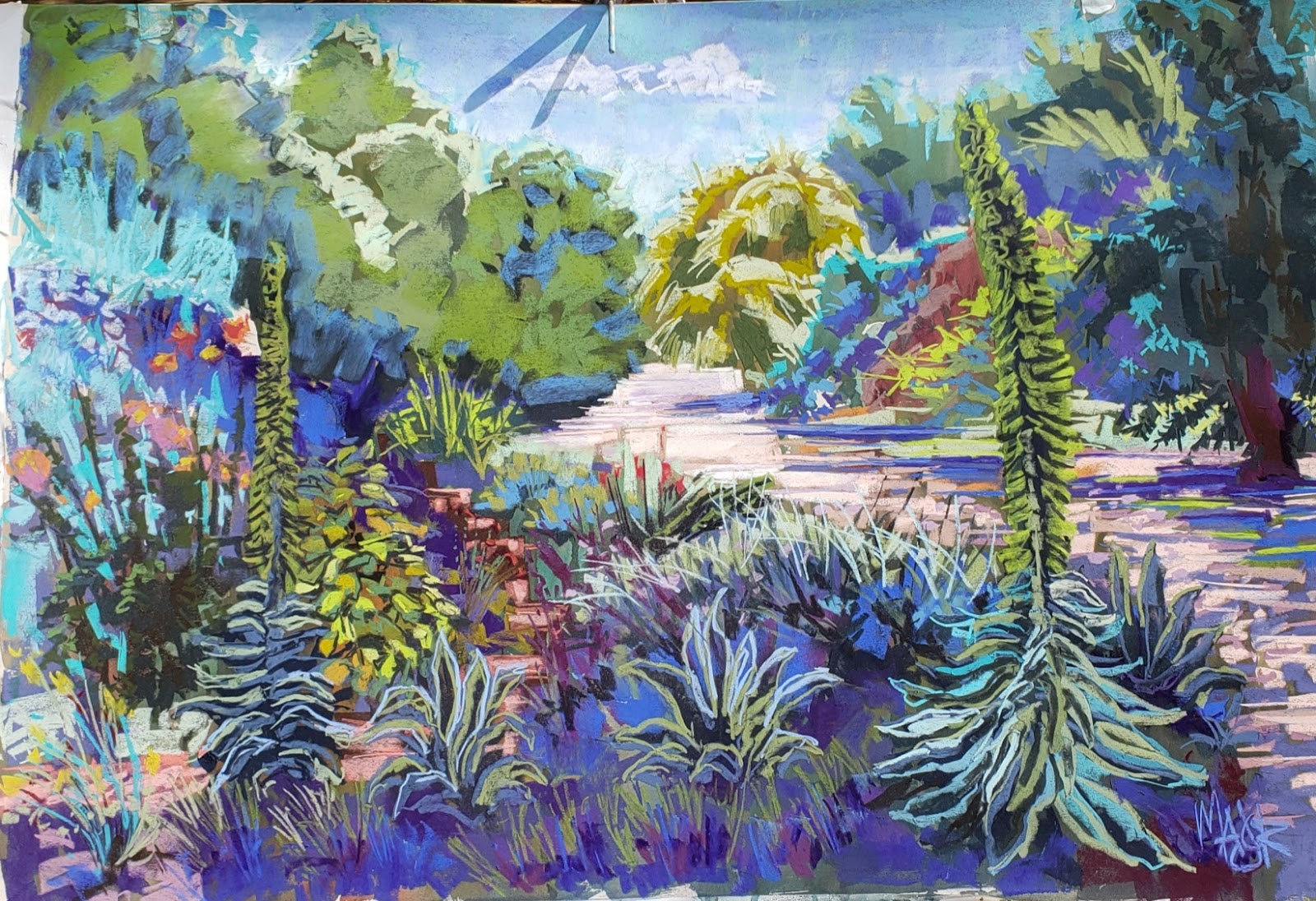
 For the first time in 2 years I took some time to plein air paint.  As usual, I was a little too ambitious.   The size and scope of this painting was not in my green zone.
This painting is mixed media.  It has an under painting of watercolor with a finishing  layer of soft.pastel.on sanded paper.  The painting measures  approximately 32"X 46".

Tuesday, April 30, 2019

Finishing Your Thought

Finishing your thoughts in art is a simple idea which some of my paintings have trouble expressing.  The expression of your ideas is central to effective communication within the painting. Competing ideas have to be eliminated.  Spontaneity balanced by a well articulated plan. Distractions must not be allowed to take center stage. Stick to the plan. Whether painting in the studio or en plain air, your attention span will be tested.  Decide what your effort is to convey. Do the thinking on the front side so you can paint without conflict later.  Have your idea be strong enough to hold your attention to the end.  Write it down and refer to it before your work begins. Your stronger paintings are most successful because you did not have conflicting ideas or messages.

Monday, March 25, 2019

Monday, December 10, 2018

The light refraction from the door on the wall.  A simple daily reminder of the beauty that surrounds us.  If we choose to look we will see.

Friday, December 7, 2018

15x18 graphite on museum  board.  Sunset at Crescent Bay.  In order to get the darks dark enough I had to expand my materials and techniques.  I first tried using a litho pencil.  Although it helped darken areas that needed it, it still had too grainy a finish.  I then rubbed down the drawing with rubbing alchohol.  This did darken and blend the drawing but it also made it impossible to erase or blend further.
This was the first time I tried this technique.

Technique is a function of the artist's need.  To further your vision you must be willing to take chances and risk the outcome in order to grow.

Friday, August 10, 2018

Fall Morning in the Canyon

A quick sketch to place the shapes.  Early corrections completed before moving to the next step in the painting lead to a better overall painting.
In this painting, I wanted to establish the atmospheric perspective at the beginning.  
Normally I would establish the darker colors first and then work semi-progressively towards the lighter colors.  
The main shapes are in place.  There is room within the shapes for the values to get darker or lighter.  You can see how glossy the surface is from the saffron oil.
Working to get the shapes and the values of the shapes adjusted.
Adding the smaller shapes within the composition and balancing them to the other shapes in the painting.
It is critical at this juncture to not disrupt to proceed too quickly.  The accuracy of the shapes and the placement of them must keep evolving in relation to each other to make the composition believable.
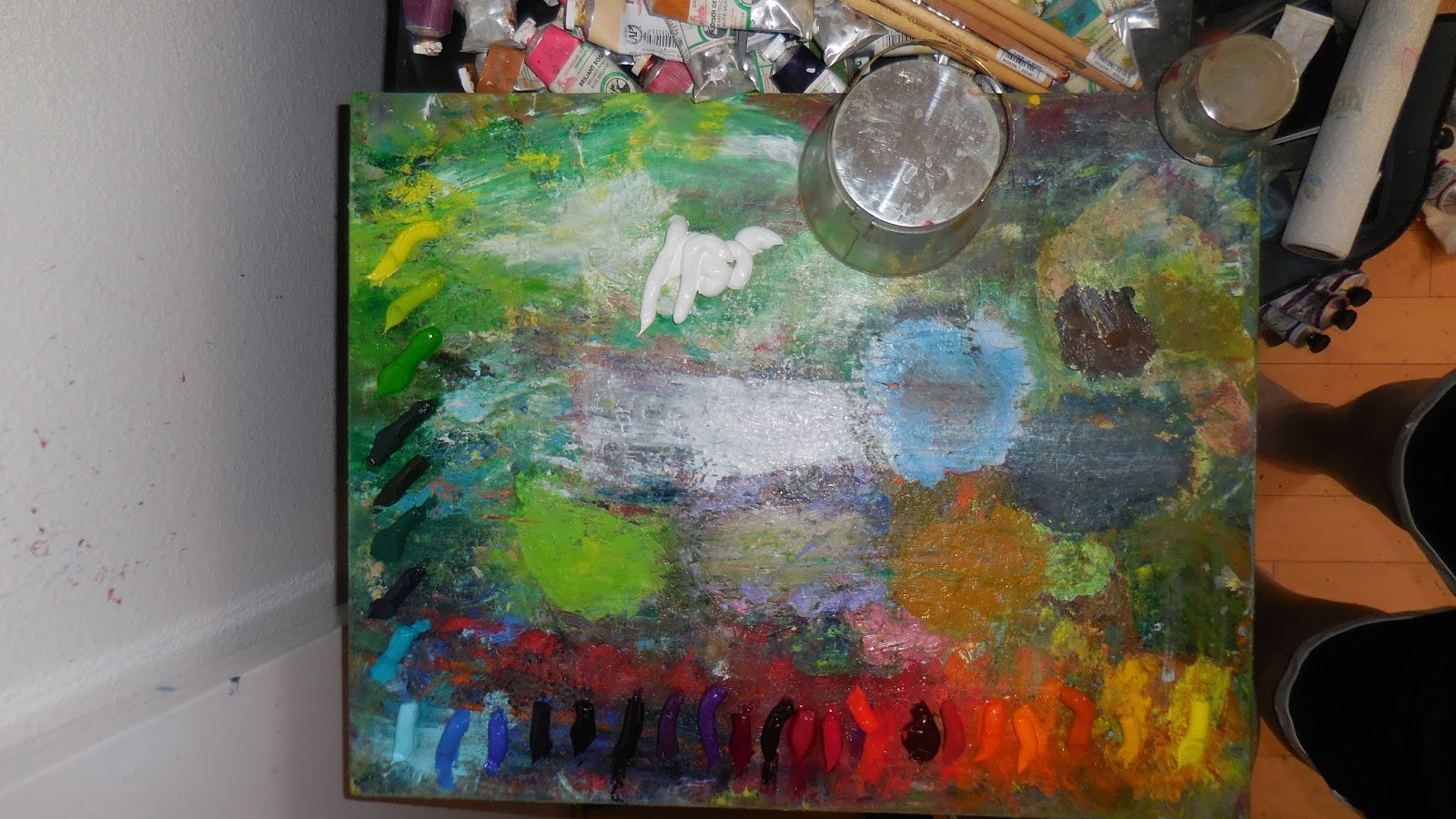
I now have 28 colors in my pallet.  I am not sure how I would characterize my pigment choices.  You could call it a split compliment or prismatic pallet.  My most recent additions are transparent orange and brown pink.  I know a lot of painters talk about keeping their pigment variety simple so that they can master their paint mixing.  I really enjoy the mystery of the possibilities.  The discoveries made are not slavishly committed to memory.  What is the benefit to dialing in your four color pallet if all of the colors you can make with it are dull and uninspiring?  I believe in complexity.  I like the idea of having a lot of different paths to finding a color.

As the painting progresses, I am using additional colors and values to redefine the shapes and add progressively smaller and less critical shapes.
Refocusing on the atmospheric perspective by making the shapes in the foreground darker and the background lighter.  Balancing all of the values between to insure a natural flow.
Creating larger contrasts in value in the foreground will make the background push itself back further.
Developing subtle changes within the shapes and adding smaller and smaller divisions within the painting.
Now some of the highlights come into play.  Trying to push myself to push the value dynamics.  How far can I push the contrast between the lightest lights and the darkest darks?
Bringing the middle ground into balance with shape differentiation, color variance, and value.
Final value adjustments.
Final details being added and refined.
Is it done?
The finished painting 24"X 36"
The value shot.
The detail shot.

Wednesday, August 1, 2018

New Process and Materials

It has been over a year since I have used pastels to paint.  For this painting I tried out UA 400 grit paper for the first time.  My love of sanded paper led me to UA with the unavailability of Wallis paper.
I bought two different sizes of paper.  I used the smaller size because I was not sure how my first experience using rubbing alcohol would turn out.
Because it was my first attempt at using alcohol to build the under painting, I will reserve my judgement on the process.  I blocked in the rough value and colors of the composition and sprayed the rubbing alcohol out of a spray bottle.  I did not use hard pastels and I did not use a brush or cloth to blend the colors.
The effect of the alcohol did seem to mute the colors a little and it did fill some of the tooth of the paper.  It also seemed to soften the edges of the marks that I had made during the block in.


I worked to evolve the shapes, values, and colors to strike a balance.  Of particular interest to me were the shadows on the path and the subtle values within the woods.  
The absence of context increases the abstract nature of the sub-elements of the painting.
The variety of color, pressure, and mark making increase the implication of detail within the painting.
The overall idea about the painting enables the diversity of mark making within the painting to be pulled together within the composition.
Simplification is not an objective it is unavoidable.  It would take every moment of my life to recreate the detail in this one painting.  The simplification of the painting is the rationalization of the mind when confronted with complexity of nature.
These marks are a unconscious system of short hand abbreviations.  They enable me to react to the landscape without becoming bogged down.
I approach the development of the painting as a series of veneers.  Each veneer is laid down over the one beneath.  The objective of each veneer is to combine with the others to move closer and closer to my vision of the painting.   Each layer may address different needs within the painting.  For example a layer may be about correcting values.  Another may enhance shapes.
While there was a need to darken the shadows among the trees there was also a need to lighten trees in the background.
There is also need to clean up the shapes of the shadows on the path.  They are too jagged.
The pattern of values in the foreground is disruptive to what I am trying to convey.
The finished painting feels right.  It is not as accurate as I had hoped for, but it gets me close to the feeling when I walked upon this shadowed path.
Evolving details become more supportive to the overall intent of the painting.
As some details become simplified, others evolve into more complex ones.  Here the sunspots have become less detailed while the transition from the trees to the path have become more detailed.
The unusual handrail across the bridge are added in at the very end.  There is only one chance to get this right.  
Changes within the painting spawn changes throughout the painting.  One reaction leads to the next and to the next until the entire painting has moved to the point in it's development where you can just let it go.


The final result.  Shadowed Path soft pastel on sanded paper.  20.5"H X 27" W
The value shot lets me know if I got it right.  If the values are right that is more than half the battle.
The detail shot allows me to compare the paintings within the painting.