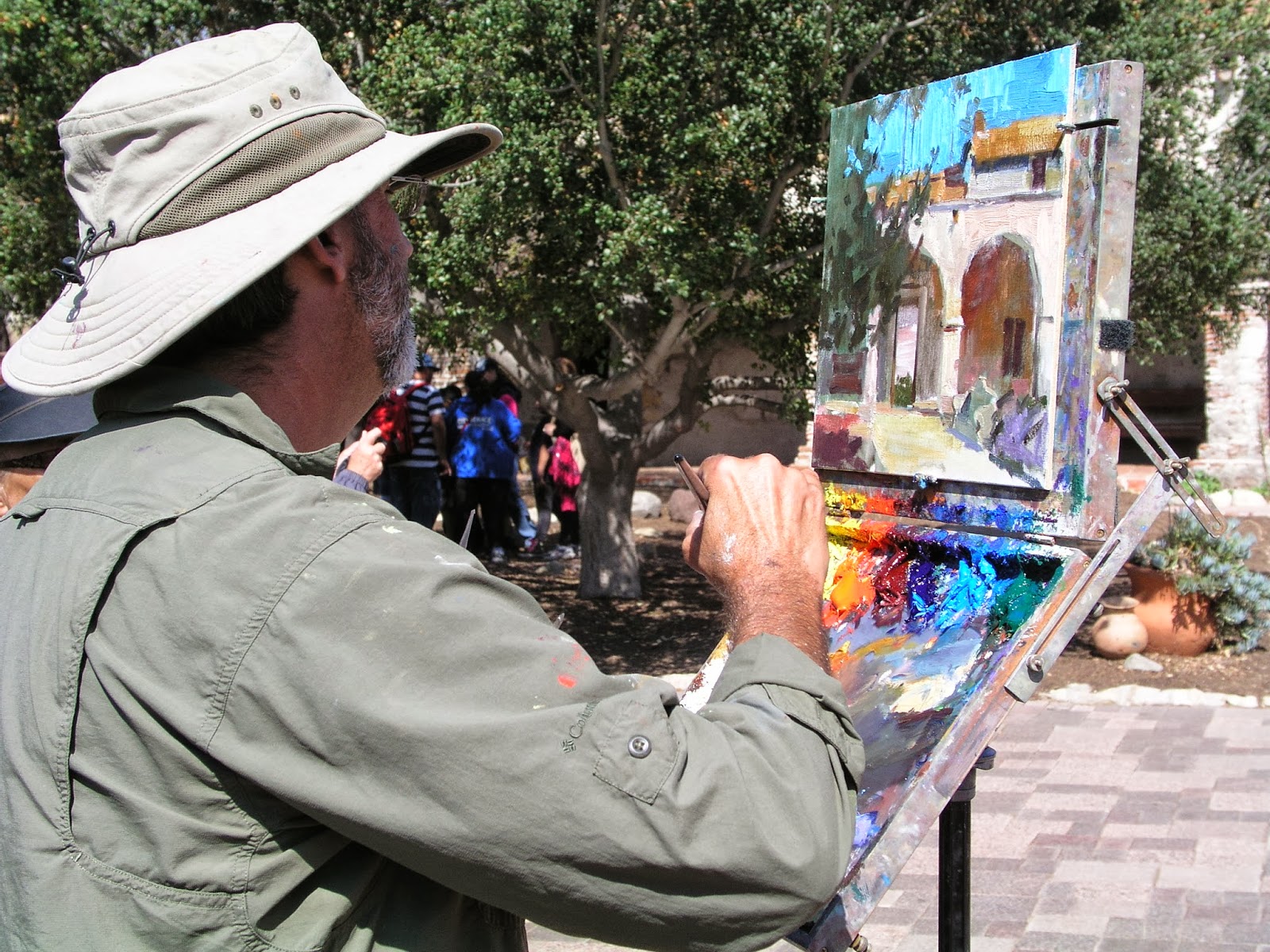
The feeling of painting outdoors. The start begins with searching my thoughts about the possibilities. There is a general anticipation and a sorting process where I think about what kind of day it will be in some of the areas that I would like to paint. I am thinking what the actual painting will feel like from a best case scenario. At this point I am not even sure where I will be painting. These feelings and thoughts are about the colors and what they will be like at the location I am trying to decide on.
When I get to the location I scout it out. I am trying to pick the best spot based on the time of day. I am looking for the most interesting composition. My personal trends and interests guide my decision making.
The board's under painting is determined by the type of day and the potential subject I am going to paint. Anticipation builds as the board is created. I get a fuzzy feel for the colors that will work on the board.
I set up my gear and determine the details of the composition. Based on the size of my board and the subject that I want to paint I lay out the preliminary design in a sketch.
Once I start drawing everything starts to change. I feel a tremendous sense of urgency. As I begin to draw everything begins to fade out of focus except for me, the landscape, and my drawing.
I lose track of the time. I am constantly trying to observe the details of the painting. I am comparing each part of the painting to every other part of the painting. There is an intense awareness of the painting at the expense of everything else. There is a feeling of tunnel vision where everything else on the peripheral goes out of focus. Although I can still hear thing around me it is like someone turned down the volume by half. My other senses and needs become reduced. It is like I am at the center of a tornado. My mind is the calmness and the act of painting is like the wind. There have been times when I don't realize that I am getting sun burned until I reach this point when the painting is done and I snap out of this trance like state as if I was hypnotized and suddenly brought to. When I am painting I don't know I am thirsty until I finish the painting.
Wednesday, November 6, 2013
Monday, October 28, 2013
Thomas Jefferson Kitts Paint Out-Mission San Juan
Thomas was firing off his thoughts in between putting the paint down. The following are some of his thoughts at the beginning of the painting session:
- There is no substitute for getting in your painting mileage. If you want to be good you have to put in your time.
- It is more important to get 100 starts than 100 finishes. You will learn much more from a problem solving stand point.
- Painting the same subject over and over again will help you develop because you will be able to get farther in the painting each time you paint the subject. It will point to the new territory to go into.
Thomas Jefferson Kitts finishing his painting
As he continued to develop his painting, Thomas would jump around and work different areas of his painting. Similarly, Thomas would skip around from topic to topic. Thomas continued to share his thoughts like they were springing from his brush as he worked the different areas of the painting.
- He paints with the pallet at the same angle as his painting so the colors on both surfaces match.
- Thomas said he is working on painting without solvents because of health reasons and in order to develop his color.
- Thomas discussed his type of painting as planar-meaning he paints the color shifts of his subjects based on their relation to the source of light.
- Thomas discussed the foundation of his painting process. His focus on maintaining a notan throughout the course of the paintings development is key. He continually returned to this concept throughout the painting. He asked the group if he had maintained his notan up until the finish.
- Where the notan focuses on a black and white value pattern used to build the composition, he uses color temperature as a basis for the color buildup.
- If you start with the right temperature in your initial lay in, it will provide a solid base for the rest of the color choices in the painting.
- In order to understand temperature before you start your painting you can hold your brush over your canvas. If the shadow is cool then the light is warm and vice verse.
- Thomas starts his color super saturated and then brings down the temperature.
- Avoid chalky by painting from dark to light.
- For his shadows he starts with a neutral color and adds color to it.
More Thoughts From Thomas Jefferson Kitts
- He really likes lead paint because of the way it drags across the canvas, it avoids being chalky, and does not influence other colors as much as titanium white. It also allows better color saturation.
- Thomas avoids chalky looking painting by painting from dark to light.
- Avoid painting lights into darks and leave the darks transparent.
- Look for the biggest value contrasts and then the biggest hue contrasts.
- Work you painting from shape to contour to line and then dot.
- Working a shape from light to dark in opposition to dark to light creates an interesting contrast.
- When establishing masses build vertical masses early because it lends itself to planar development later in the painting.
- You want to suggest the time of day but don't lock yourself in and understand you must keep your initial impression of the time in your painting.
- When creating the composition through the choice of shapes and values resist suggesting shapes through the highlights until the end. Hold on to the notan till the end of the painting and then ice the cake. Keep the light and dark areas of the painting the same value to maintain the notan until the end.
- Establish distance in the painting by maintaining relationships between the foreground, middle ground, and background.
- Massing values, hues, and temperature and relating them to each other is key to a successful painting.
- If you can relate two of the three elements you will have a successful painting.
- There are no same colors in nature.
- Once you introduce white into the painting the whole game changes.
- Keeping the painting simple as long as you can by working at getting the big shapes correct in all of their relationships between values, colors, and temperature.
- Build the painting anyway you want but need to look at everything all the time to keep the relationships correct.
- You can only paint as well as you can draw.
My Turn
Finish
Saturday, October 26, 2013
Painting is like handwriting
Painting is like handwriting. The grace and swing in the curves, ovals, and the general rhythm in the line of written words is possible when the hand easily and confidently makes the strokes.
-Edgar Payne
-Edgar Payne
Sunday, October 20, 2013
Bluffs
I was hoping to find some plein air painters. It was the last day of the Laguna Plein Air Invitational and this is a classic painting location.
|
The tide was very low so I felt that I could set up here without fear of getting my stuff wet. The fog was just starting to burn off as I set up.
This is my initial drawing of the bluffs. I would normally do a sketch but I have painted this scene enough times that I did not think it was needed. I would have liked to have included the rocks in the ocean but I liked the size of the subject on the board. I will have to get a different size board to include both next time I come back to paint.
Bluff
By the time I got this far in the painting the sun was peaking through and everything changed from a lighting stand point.
|
As I moved through the painting, I focused on elaborating the details and building up the high lights.
I worked on developing the proper relationships between the values within the bluff. I was also trying to see the underlying colors between the highlights and the complimentary colors that would accent the light.
Bluff in Laguna
At this point I had decided to take the painting in a more impressionistic manner.
From this point, it went on automatic pilot.
Done.
From this point, it went on automatic pilot.
Done.
Sunday, October 13, 2013
Saturday, October 5, 2013
Choices
After Brian finished his demo, I took his spot with my gear set up and began paining. The gazebo was full of painters. I was full of energy and I was looking forward to get Brian's critique.
Jeff Sewell was painting this view of Rock Pile during the demonstration. When Brian had finished I started painting. After about twenty minutes a man came in and said the gazebo had been reserved for a wedding and we would need to move. Brian had to go and conduct some business as he had a forty painting show opening later in the day at Pacific Edge Gallery
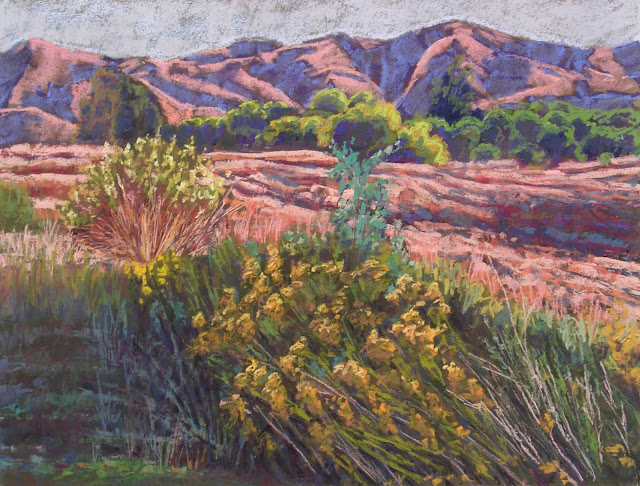
Brian Mark Taylor
At this point in the painting Brian is still deciding what his focal point is going to be. He was debating which of the buildings he would choose. He ended up picking the buildings by his brush in this photo. He would lateer make significant adjustments to the hills in the background. He really kept things simple and open to interpretation in the background. It helped him nail down the atmospheric perspective. He also altered the bottom of the painting where the water and the sand meet because the water and the sand had too similar a look. They were evenly painted all across the bottom.
This demo took an hour for him to complete. This is the result.
Brian Mark Taylor
Moving
Everyone moved out and set up by Las Brisas facing the main beach. The Santa Ana winds were blowing ever so slightly and it was hot.
By the time I moved to set up, everyone had crowded together on either side of the path leading to the beach. While I was setting up, one of the painters yelled to move out of the way with my large set up and board. whatever...I moved.
Subscribe to:
Posts (Atom)