

Saturday, May 18, 2013


Wednesday, May 15, 2013
We're Not Verbal
 |
I went to paint down at Heisler Park again. This time I went down to the beach to paint Rockpile. I went down to scout out a spot and took some refrence photos. As I came down the stairs I saw a couple of easels and knew I found some fellow painters. I approached them and looked at a painting that the guy in the purple shirt was working on. I talked to him for about half a minute asking about his painting and asked if I could paint with them when he said "We aren't verbal."
At that point as I went back to my car to get my stuff I thought that guy is a dick. He had told me he was a teacher. I wondered what kind of teacher he was.
When I got down to the beach I made my way to the opposite side of the beach. It's funny that I was willing to paint what I considered a much poorer landscape to be among fellow painters.
Whenever I see painters, I am drawn to them. I am always hoping to meet some of the top plein air painters that are out there. I am also hoping they will share some of their wisdom with me. Most of the time all I get is some company while I paint.
I just don't get it. Plein air painting is all about painting in the elements. People are part of that equation.
|
Monday, May 13, 2013
Painting Heisler
 |
I tried to draw less and block in more. The idea of doing the drawing later in the process will help maintain the detail by not putting it in too soon and covering it up later in the process.
|


Painting Heisler
 |
I have painted this landscape more than I have painted any other. There is no shortage of material where I live but there is something magic about this mix of bluff, rock, sand and ocean. This is the view looking south. The view of this seascape from the north is probably the scene I have painted the second most.
|
 |
This location was perfect for painting. This overlook was perfect. I wonder how many and what great painters have painted from this very spot.
|

Wednesday, May 8, 2013
Sage Study in the Canyon
I painted indoors and finished up two studio oil paintings but I had the urge to paint plein air. I went to the location where I painted at the end of the street because I saw a road that I thought might lead me into the Irvine land from a different location. The wind was gusting up to 60 mph which was a severe test for my easel.

 As I was starting to set up a couple of buzzards were enjoying the combination of high winds and the thermals as they repeatedly flew just a couple of feet over my head.

As I was setting up I did not notice that the wind had caught my board and blew it down the hill.
 |
I thought I might be going a long distance into the canyon so I reduced the amount of pastels that I took with me. I left my Heilman box in the car.
|

Sage Study
 |
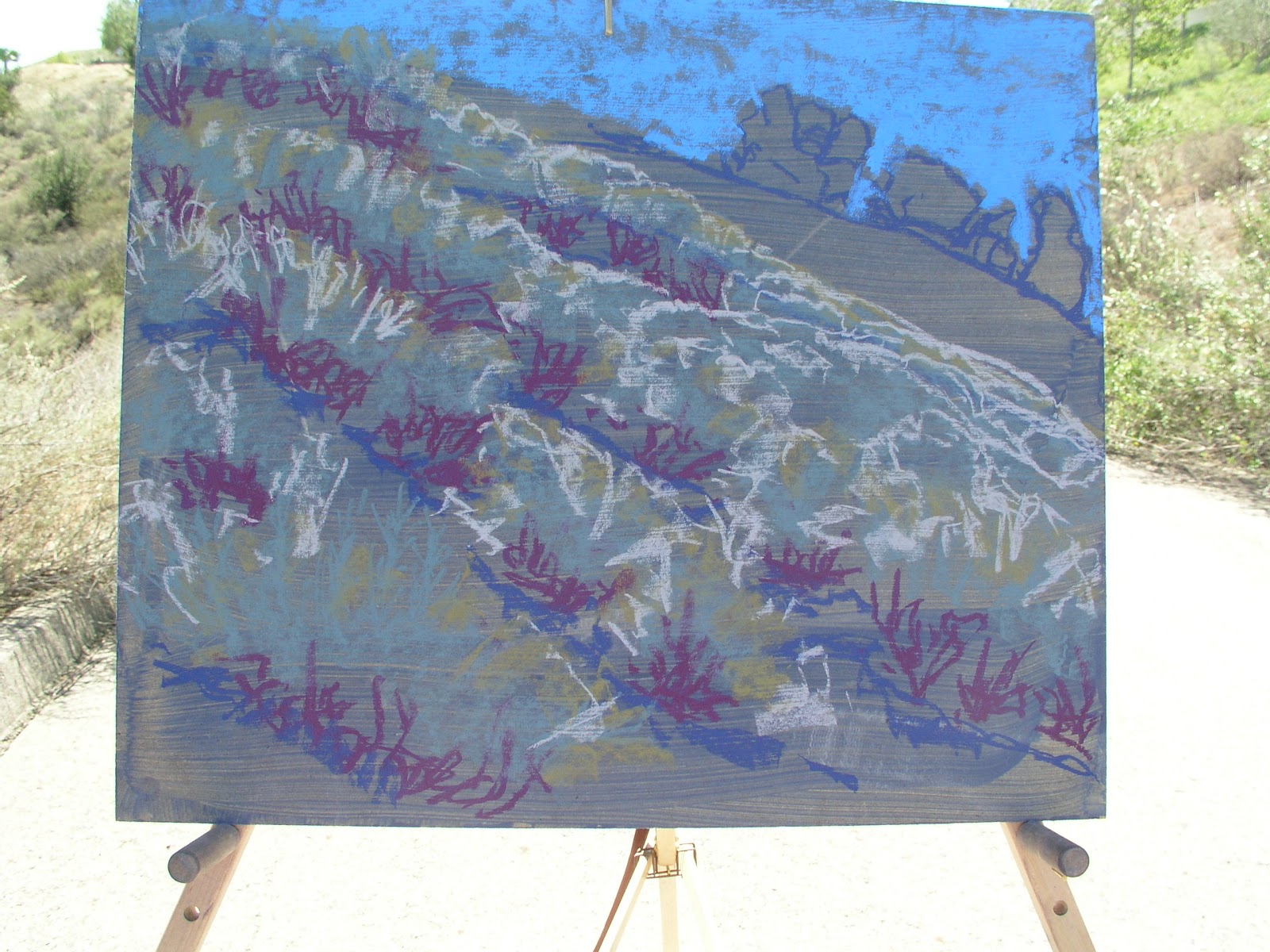
Simple and quick marks to establish the position of the sage plants.
|
 |
More simple marks to establish the lines of the hill and the trees on hill in the distance. I then add the color of the sky which sets the lighting for the entire painting.
|

Sage Study
 |
One of my common approaches is to draw the painting before I paint it. Consequently some of the great marks I make get covered, I then try and recover them later in the painting.
|
 |
In this painting I tried to not over draw the beginning part of the painting. Because the detail would be created by a number of similar colors, I had to be careful to let some of these colors to have their space.
|

I worked to complete the detail in the base of each sage plant and then work through the upper branches.
Sage Study
 |
I then started working the detail of the trees in the background and worked to create the feel of the sage moving off into the horizon.
|
 |
I then went back into the sage to set some of the different values with my limited pallet. I also created the contrast of the ground when compared to the darks of the sage.
|

Sage Study
 |
I liked the way the light in this painting came through.
|
 |
This painting was all about simpler. I chose a simpler subject. I used a simpler selection of colors. I simplified the detail of the painting as well.
|
Friday, May 3, 2013
Note to Self
Note to self: When painting in pastels don't paint after putting on sun tan lotion unless you wash your hands thoroughly.


Sunday, April 21, 2013


Monday, April 15, 2013
Painting At The End Of The Street
 |
I got a late start and wanted to paint by the house without having to hike all over the place. I found this neighborhood where the street was blocked off by this gate. So I walked to the end of the street and started to paint. I liked painting in the middle of the street.
|
 |
The clouds were flying over the hills off into the distance constantly changing everything. The hills seemed to melt into each other. The light was at my back and slowly lowering itself and changing the shadows by the minute.
|
Painting At The End Of The Street
 |
This board is about 24"X36" and is made with fine pumice gel and Smalt hue acrylic paint. The Smalt hue is very transparent so the color of the board influences the painting more than when I am using opaque colors.
|
 |
In addition to developing the shapes, colors, and values in the foreground; I also attempted to create the feeling of distance and grab the shapes of the clouds before they changed.
|

Painting At The End Of The Street
 |
The amount of detail in all of the hills in the background was immense. My focus was not on how I was going to get it done in the amount of time I had. I just kept subdividing the space relative to the shapes within the shapes that I created while trying to capture the color and values.
|
 |
If I had done a better job at getting the shapes of the hills more accurate it would have made it easier to get to the relationship between them in the distance.
|

Painting in Black Star Canyon


I started with the background in this painting because I thought it was the most important part of the painting to get right. It had the most challenges. Some of the problems I had to solve were; the light changing on the face of the rocks, making sure that the rocks were not too bright or red so that they would stay in the back ground, getting the detail in the rocks and the trees without detracting from the middle and foreground.

Painting in Black Star Canyon
 |
As the basic elements of the background were put in I moved to the middle and foreground. Because the painting was almost entirely different gray colors I wanted to make sure that I captured the differences in value while maintaining the light key. This is an important part of any painting but for some reason it is not something I conscious about.
|
 |
I had to decide what how dark I would make the middle ground and the foreground in relation to the background so that the distance would seem believable. I also focused on the how light and blue the grays I used to help define the distance and maintaining the overcast feeling.
|

Black Star Canyon Finished
 |
As I was getting close to the finish the light began to change. The clouds started to burn off and the light fell upon the rocks changing everything. I started changing the rocks and chasing the colors of the light as it fell upon the ground.
|
 |
It was at this point that I had to remember how I wanted the painting to turn out and what the colors had to be if it was going to work. I grayed down the rocks and maintained the colors and values in the painting.
|
Subscribe to:
Posts (Atom)