 |
Is everything a reaction?
The simple answer for me is yes. When I wake up I am in a certain mood. My thoughts about what and how to paint are a reaction to my situational daily condition. Is it a beautiful day? I will decide to paint plein air or studio based on the weather. What color is the sky? It will help determine what color choices I make in my painting. The color that I want to paint with helps shape what subject I will be painting.
My reaction keeps shaping decisions to the point where the decisions themselves create smaller reactions like the ripples on the water. Everything I do during the painting changes everything I do on the painting. The key for me is keeping true to the main thoughts and decisions so I can stay on track with my original intentions. When that happens I have what I consider to be a really good painting. |

Sunday, January 27, 2013
Is everything a reaction?


Tuesday, January 22, 2013
My Favorite Places to Paint-Coal Canyon
 |
Coal Canyon is one of my favorite places to paint because of the scenery as well as the access to it. Because I live 5 minutes away I am able to paint plein air without the extended travel time. Because it is close I am able to explore to a much greater degree. I am not worried about ruining a once in a life time opportunity. The wealth of subject matter is wonderful. All three of these pictures are taken within one mile of each other. In fact these are all about 400 yards from each other. I love the varied mood of the hills.
|


Monday, January 21, 2013
Banking on Art
 |
I had a piece of my art in the Banking On Art show. The show was put on by the LPAPA. It was at the Wells Fargo Bank in Laguna Beach on Ocean Blvd.
|
 |
This is the piece I had in the show.
|

Banking on Art
 |
These were some of the paintings in the show that really caught my eye. It was nice to see the different styles and technique.
|


Saturday, January 19, 2013



 |
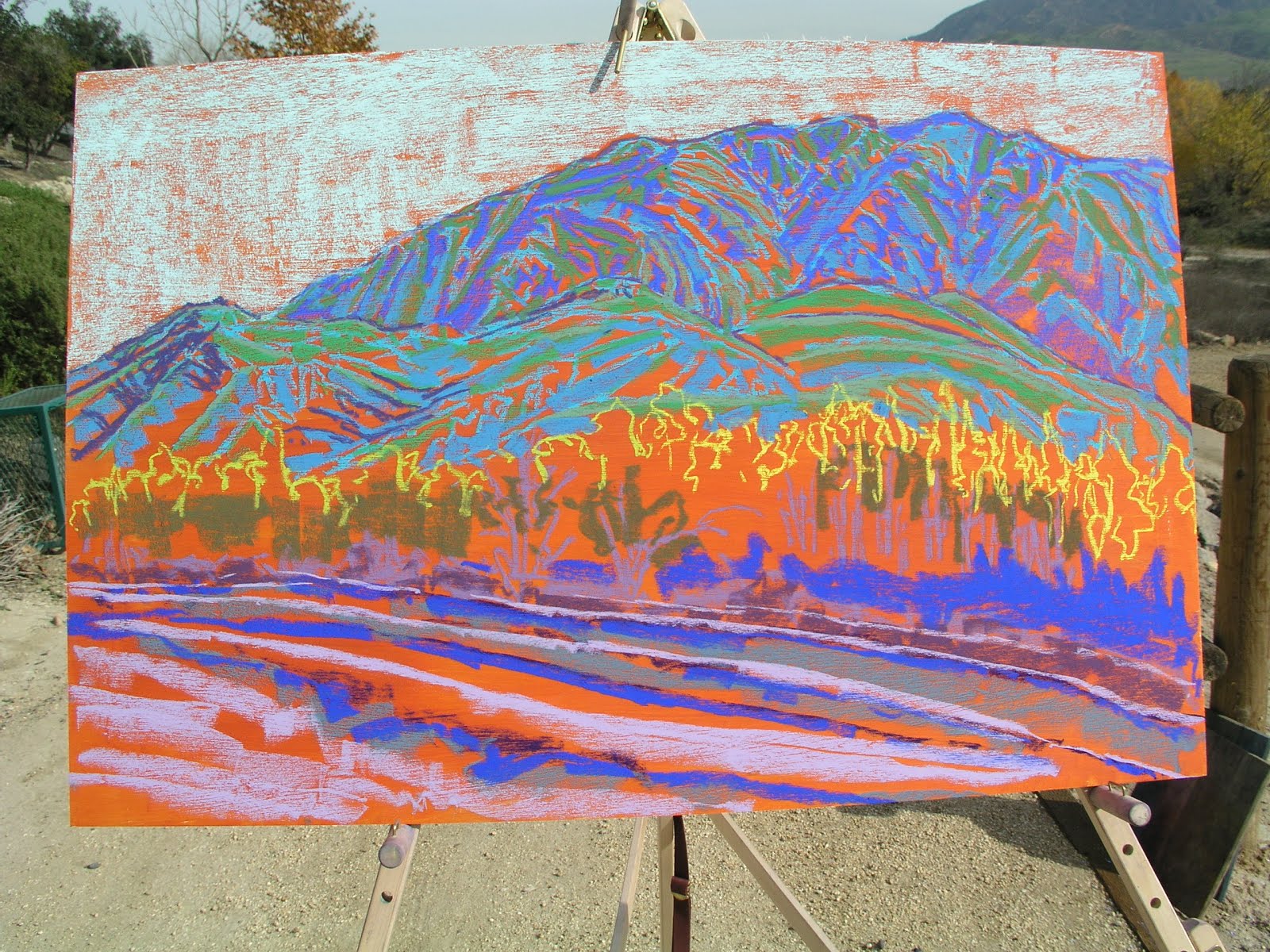
It was a gloomy day and it looked like it was going to rain but I decided I was going to paint anyway. So I set up by the car so I could pack it in quickly if I needed too. I tried painting on a red underpainting because I wanted to change the feel. I thought I would work off of a purple/gray starting point and develop it from there.
|
 |
As with everything in plein air painting it all changes so quickly.
The painting goes where ever it has to. You hope that it goes in the right direction.
|
Tuesday, January 15, 2013
Painting Along the Hills
 |
I tried to keep the marks fresh and not go back into the areas but as the sun came out from behind the clouds everything else changed too.
|
 |
In the end it seemed like I was trying to save the painting more than creating a painting. I was unhappy with the composition and the colors. There were a couple of wins for the painting. I will take some of the technique I used for the foliage in the upper right hand corner.
|
Thursday, January 10, 2013
Time For A New Pallet
 |
As I was painting down by the Santa Ana River my Heilman slid off of my easel and hit the ground. It sent my pastels all over the ground. It was a tough interruption because of the time it took to get everything back into the box.
|
 |
This is the remains of my pallet on the ground. It is kind of funny that the day before I was examining goals for this year and I thought I should change my pallet. I thought there were too many colors that I was not using and that there were too many colors that were too similar to others in the pallet.
The qualifications for my pallet going forward will be that each color will have to stand alone for its beauty-it will not be enough for it to accentuate the other colors in the pallet-other than the full values available to me.
|
Wednesday, January 2, 2013


Painting with Debra Huse
 |
We met at a dry dock in Newport Beach close to her gallery on Balboa Island. Debra Huse Gallery This was a great opportunity to paint with Debra. She had just recently won a second place ribbon at the 14th annual LPAPA Invitational. LPAPA
|
 |
She was painting on a canvas tinted with raw sienna. Debra said she uses raw sienna because it helps establish the overall tone of the painting and that the color is not too dark. She started her painting with small dots arranged on the canvas to get the overall size of the boat established on the canvas. Debra did not start with a thumb nail sketch or any other prep work before she started painting. She drew her subject with raw sienna as well. As a marine painter she had a lot of insight that I found helpful. She said to find the face in the boat. Start with the windows and work out from them to get all of the elements of the face related to each other properly. She said if it is not working it is not working and to wipe it out.
During the course of her drawing in the boat she would smudge sections that did not relate to the rest of the boat. As she blended in the sections it ended up helping to establish the values of the boat. It also helped her establish the overall shape of the boat. Once the shape was set Debra added the main colors of the boat. Debra said to make sure to get all of the big shapes before you freak out.
Once the drawing was completed she shared some thoughts about her process. Debra said she should make some decisions about the painting at this stage because of the light and where the shadows were headed. With the shadows shifting Debra put them onto the hull of the boat before moving on with her painting. One of her thoughts was that a boat yard should be "gritty". The painting shouldn't have too finished a feeling. One of her big decisions was what to do with the sky. Should she add masts to the painting, a flag, or how much vibration should be in the sky?
|


Monday, December 17, 2012
Painting in Santiago Canyon
 |

I picked this spot along Santiago Canyon Road because of the Sycamore trees hanging over the dried grass in the valley. I liked the shadows upon the grass, the oaks on the hills, and the Sycamore trees shape.
|
Santiago Canyon Painting
 |
The size of the masonite board I was painting on was 24"X36". It is treated with pumice gel and acrylic paint to hold the pastel. I wanted my subject to be more intimate than it had been in recent paintings.
|
 |
This painting will end up being a studio painting. The color needs work. The shapes need refinement but the arrangement of the elements and the feeling of the light will serve me well when I take this to a studio work.
|

Monday, December 10, 2012
About Pastels / Framing Pastels
 |
|

Thursday, November 29, 2012
My Current Set Up
 |
This is the latest version of my plein air set up. I am continuing to make my own panels from masonite with pumice gel and acrylic paint. The pastel box is the largest made by Heilman. http://www.heilmandesigns.com My easel is made by http://www.takeiteasel.com My set up is about my desire to paint large plein air paintings without having to settle on pastel selection. My typical painting size is about 24"X36". The easel can hold paintings much larger. My pastel box carries about 200 full sticks which I like to have for the diversity of stroke making and color selection.
|
 |
In my backpack I carry artist tape, glassine, fixative, wet micro fiber wash clothes in a plastic bag, my camera, a view finder, my sketch book, value markers, and a pencil.
|
Sunday, November 4, 2012
Pictures of the Laguana Plein Air Painters Invitational
http://www.flickr.com/photos/lagunaartmuseum/sets/72157631830655561/?page=2
The link above is a flickr link for the LPAPA Invitational which just took place two weeks ago. Here are some of the pictures I took at the event.
 |
This painting won the best of show. It measures 16"X20" and is called Laguna Beach Coast. His web site is http://billyoart.com The amount of paint he puts down is impressive. I love how clean and bright his paint is. The paint is so thick that it creates shadows on the surface of the painting. I would love to be able to paint like this. It is not often that I feel that way.
|

 |
Heisler Park painted by Billy O. Amazing.
|
Monday, October 29, 2012


Painting in Coyotee Hills
 |
When I moved to California in 79 I came with an appreciation for unspoiled open spaces. I had lived in Michigan, Ohio, and Virginia. In all of these places I was able to quickly lose myself in nature because it was close at hand. When I came to California with my parents our home butted up against this land which was oil land. It was fenced off with barb wire. I was never able to get into this space. There has been a fight over what to do with this land.
|
 |
The fight as always revolves around making money off of the land. The issue is trade off- space for development and you will get some token space for a park or parks or fight the City of Fullerton and their bed partner Chevron and take the land back. Politics generally make me sick. Rarely is it about making sure the right thing gets done. I am not a resident of Fullerton but this is just another piece of land about to vanish. http://www.votenow.com/blog
|
 |
So with all of this about to happen I decided to go paint in Coyotee Hills. I decided to paint a little smaller. The bottom painting is the smallest plein air painting I have done to date. I liked the subject and the shape of the painting on the bottom and will probably use it for a larger studio painting.
|
Tuesday, October 23, 2012
Jeff Horn Painting at Little Corona Del Mar
 |
I had this amazing day of art last week. I watched many of my favorite plein air painters paint at the Laguna Beach Plein Air Invitational, I met many plein air painters who came out to paint because of the event, I painted for the first time on my new easel above Crystal Cove, and then I found Jeff Horn painting down at Little Corona as I was taking reference photos of the sunlight on the amazing rocks by the ocean.
|
 |
I came across Jeff Horn painting the same scene I had painted a couple of weeks earlier. I watched as he "struggled" with his painting. He was having this on going dialogue with himself as he was tweaking his painting. When I came up it looked like he was almost finished. He continued to pull things forward and push things back as he tried to get the amospheric perspective so it read right. It was difficult because the rocks were deep in shadow in the distance and the light as the sun was setting was very warm and bright. He used everything available to him to get the marks and tones he wanted-I was probably bugging him while I talked to him but he was very nice and I thought it was awesome of him to share some of the thoughts about his process with his painting as he worked on it.
|

Subscribe to:
Posts (Atom)